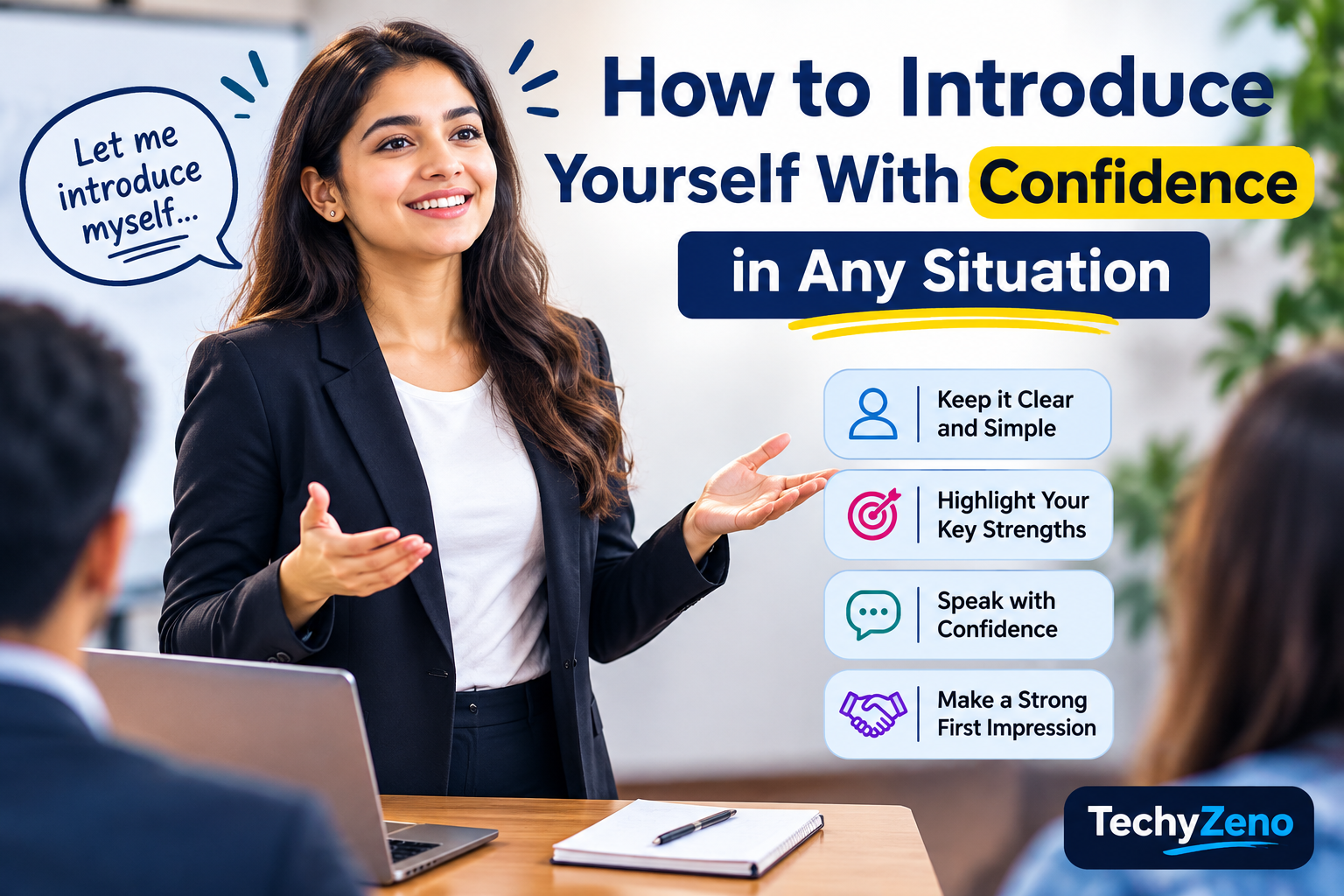

Do you feel worried before introducing yourself? Or do you have a challenging time finding anything to say when “Tell us about yourself” is the best question during a video call or meeting in a company or with a group of strangers, at a networking mixer, or during a job interview? How about when you need to briefly explain how to introduce yourself to a new team or company?
Whatever the scenario may be, know that developing a strong and confident self-introduction is a learnable skill – and one you can practice!
What a Good Self-Introduction Should Include
When thinking about what comprises a good self-introduction, most people make the mistake of thinking that they should be providing a comprehensive overview of themselves
In reality, the most effective self-introduction should provide the listener or reader with:
• Who you are,
• Why you are in this specific situation (why you are relevant),
• One detail that will help someone remember you,
• And the opportunity to pass the conversation back to you.
We noticed that I did not include “Impressive Fact” on that list. Your self-introduction should not be a highlight reel of your accomplishments, and it should not feel like you are auditioning for a role. It should be able to help the other person, so you know that who you are and how you fit in the current context. For example, an effective self-introduction from a developer will sound different when talking to a potential client versus their friend at a social mixer – the context will dictate what details to include and what to say. However, the basic structure of it (more on that below) will always remain the same.
The Secret to an Effective Self-Introduction (And a Template You Can Use!)
If you only memorize one thing from this article, let it be this:
An effective self-introduction always includes:
1. Present (who you are and why you are in this situation),
2. Past (one relevant detail),
3. And Next/Now (what you are looking for or hoping to happen as a result of this interaction)
Here’s an example:
“I am currently managing content outline strategy for a fintech start-up. Earlier, I was writing in the SaaS space for an agency. I’m hoping to connect with other content writers in the tech space to discuss collaboration possibilities.” You can see that how this example has all three parts. The first sentence provides the present context, the second sentence provides the relevant knowledge experience, and the third sentence defines what the speaker is hoping to achieve as a result of this interaction.
Next time you need to know how to introduce yourself, use this three-beat structure and see how it helps you feel more confident when you are saying it. The more you use it, the less you will think about it, and the more natural it will sound.
How to Introduce Yourself: Step-by-Step Guide
Let’s break down the three beats of an effective self-introduction and go more in-depth on what each part should entail. This way, you can begin tweaking and adjusting based on your specific scenario, audience, and context.
Step 1: Say your name clearly and articulately at a normal pace, and pause for half a second after saying your name
This can seem like an obvious step, but many people make the error of rushing this part and blurting out their name so fast that the listener barely catches it. By saying your name slower and pausing for half a second after you say it, you will give the listener a slight breather and allow them to absorb that information.
Step 2: Provide context
After stating your name, provide relevant context so that the listener knows who you are and why you are in this situation. Context can take the form of your profession (e.g., “I’m a marketing director”), your reason for being in this situation (“I’m here to learn about digital transformation trends”), or a brief description of how you know the person you are talking to (“I know you from the UX meet-up last month”). Whatever it is, providing context is vital to making sure the other person can understand your self-introduction.
Step 3: Make it memorable
This is where you can make your self-introduction interesting and memorable for the listener. You want to include one specific detail here that will help them remember you. You can include something that you are doing presently or a fun fact about yourself. If you are having a tough time thinking of something specific to say, remember that vague and generic statements will not resonate with the listener. Instead of saying, “I love helping people,” try saying something like, “I really enjoy helping people learn data analysis.”
Step 4: Adapt to the situation
Whether it is a formal or informal setting, it is important to know how to adapt your self-introduction to best fit the context. As mentioned earlier, a 30-second-long self-introduction is perfectly fine during a formal mixer but probably too long for a message in Slack.
Step 5: Pass the conversation back to the listener
An effective self-introduction should always end on a note that invites the listener to ask you a question or continue the conversation. You can do this in a variety of ways, including by asking the listener a question in return (“What about you?”) or by giving them a specific ask (“Could you share with me your thoughts on X?”). Doing so will make the conversation feel more like a dialogue and less like a monolog.
How to Introduce Yourself in a Job Interview
When asked to introduce yourself in a job interview, remember that the interviewer is trying to determine two key things: if you are a good fit for the role and if you can communicate effectively under pressure. Therefore, it is best to avoid long-winded answers that may prevent you from providing relevant information succinctly
Once again, you can use the three-beat structure of Present, Past, and Next to structure your response. For the Present, describe your current role or provide a brief overview of what brought you to this moment. Next, use the Past beat to describe one or two experiences most relevant to the position you are applying for. Finally, use the Next beat to explain what made you apply for this role or position. Here’s an example:
“I am currently a marketing coordinator for XYZ Company, where I specialize in email marketing. Previously, I have worked in social media marketing for a non-profit organization. I applied for this position because I am really passionate about leveraging data for marketing purposes, and your company has always been at the forefront of that space.”
That was a 60-word response, and it tells the interviewer everything they need to know to continue asking follow-up questions. It’s always a good idea to practice a few variations of your self-introduction to ensure that you can say it clearly and concisely without stumbling over your words.
How to Introduce Yourself in an Email or DM
Asking to introduce yourself in an email or a direct message (DM) is always a good idea when you need to establish your credentials before asking for something. Unlike face-to-face conversations, you can always edit your message before hitting the send button
Therefore, it’s best to always include a subject line, a one-sentence opener that provides context, relevant details that will help the recipient remember you, and a specific ask.
Use the example below as a model for introducing yourself in an email or a DM:
“Hi Priya, I’m a UX designer who has been following your work on accessibility features at your company. I’m reaching out because I would love to hear more about how your team approaches user testing – would you be open to having a 15-minute call sometime this week?”
Note how this message is brief but includes specific details and a clear ask. On the other hand, if you are introducing yourself to someone you already know, you do not have to follow the three-beat structure. For example, here’s how you can introduce yourself in a warm referral email:
“Hi James, Sarah Coleman introduced me to you, as we are both working on similar supply chain initiatives. I’m a product lead for a logistics start-up and would love to discuss some ideas with you.”
Notice how in this example, the sender did not repeat their name because they were referred by someone else who already knows who they are. That way, the message flows more smoothly while still providing all the relevant information.
How to Introduce Yourself to New Coworkers or a Team
When starting a new job, you will be required to introduce yourself to several people, including your manager, your team, and potentially even the whole company. While your self-introduction will follow the same three-beat structure, it will be slightly different for each scenario, depending on the audience. When introducing yourself to your team or manager in person, keep your introduction short and simple. Here’s an example:
“Hi everyone, I’m Marcus, and I will be the new backend engineer working on the payments team. I moved here from Chicago and have yet to find a decent place that makes deep-dish pizza, so let me know if you have any recommendations!”
If you are introducing yourself to your team or manager virtually (over a video call or in the team’s Slack channel), the same principle applies, but you may need to provide slightly more context since you can’t read each other’s body language. Try adding more specific details about your background or even a fun fact. You can even mention your time zone if you are not in the same location as your team. Remember that people can always ask follow-up questions if they need more information, but the more context you provide, the more they will remember you.
Common Mistakes When Introducing Yourself
Some common mistakes that people make when introducing themselves include:
• Rambling on about their entire life instead of including just a couple of relevant details,
• Making their introduction too generic and boring by not providing specific information,
• Rushing their introduction by talking too fast or avoiding eye contact,
• Using the same introduction in all contexts,
These mistakes tend to happen when people get nervous or are unsure about what to say during an introduction. In most cases, practicing a well-structured introduction out loud will eliminate most (if not all) of these issues.
Sample Elevator Pitches (Introductions) You Can Use & Adjust for Different Scenarios
Networking Mixer: “Hey, I’m Alina, and I run a design agency that specializes in working with non-profits. I’m hoping to connect with fellow female founders to discuss collaboration opportunities. What about you? Why are you here tonight?”
Job Interview: “I am currently a project coordinator for a construction company, managing timelines for several projects. In the past, I have worked in the logistics space as an operations specialist, where I gained the majority of my project management expertise. I’m hoping to leverage that experience in this role.”
Day 1 at a New Job: “Hi, I’m Devon, and I will be your new customer success lead. I have spent the last four years working for a start-up in a similar capacity, and I’m excited to learn more about how we do things here. Feel free to reach out with any questions.”
Cold Email Introduction: “Hi Tom, I’m a data analyst, and one of my favorite ways to spend my free time is by reading your team’s blog posts about forecasting. I’m hoping to ask you a few questions about how you approach seasonal demand forecasting, so would you be available for a call sometime this month?”
Common Text Slang Meanings You Should Know
Digital conversations are filled with short forms that can sometimes be confusing. Understanding popular slang can make texting easier and help you follow casual online conversations. If you are wondering about WSG meaning, it commonly means “What’s good?” and is used as a casual greeting. WTV meaning is usually “whatever,” often showing indifference. MYF meaning in text can vary by context, so checking the surrounding message is important. SNM meaning in text may also have different interpretations depending on the conversation. Similarly, IYKYK means in text “if you know, you know,” often referring to an inside joke or shared experience. Finally, ALR meaning in text is commonly “alright” or “all right,” used to acknowledge something or move a conversation forward.
Conclusion
Now that you’ve finished reading this article, you should have a good understanding of how to introduce yourself effectively. Remember that a good self-introduction always follows the three-beat structure of Present, Past, and Next. The more you practice this structure, the more natural and confident you will feel saying it. Additionally, always remember to adapt your self-introduction to your audience, and do not forget to pass the conversation back to the listener by asking them a question or providing a specific ask. Using the examples provided in this article as a template should help you feel more confident and prepared the next time you need to introduce yourself. For more career and communication advice, be sure to check out more articles on Techyzeno!