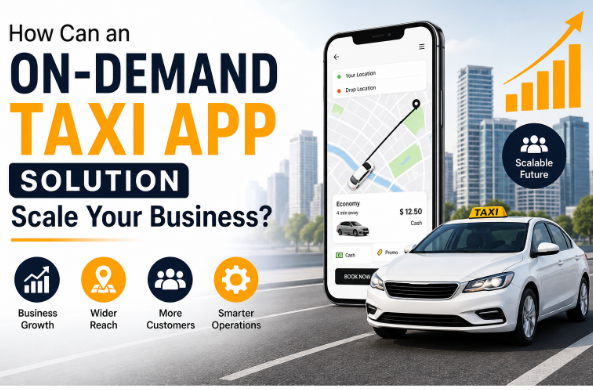

Running a taxi business successfully is no longer just about having enough cars and drivers on the road. Customers now expect quick bookings, accurate pickup information, flexible payment methods, and a smooth experience from the moment they request a ride until they reach their destination. At the same time, operators have to manage drivers, bookings, payments, customer requests, and daily operations without letting service quality slip.
This is where an on-demand taxi app can make a practical difference. Instead of depending heavily on phone calls, manual dispatching, and disconnected systems, businesses can bring major parts of their operation into one digital environment. A well-planned Uber-like taxi app solution can also give operators the flexibility to start with a manageable service area and expand when demand increases.
But scaling is not simply about getting more bookings. The real challenge is handling that growth efficiently. Here are the ways an on-demand taxi platform can help a taxi business move toward sustainable expansion.
1. Expand Your Service Area With Greater Control
A taxi business may begin by serving one locality or city. Once the customer base becomes stable, expanding into nearby areas can become the next logical step. Traditionally, this means setting up additional processes for drivers, bookings, pricing, and customer support.
An app-based system can make this transition more organized.
Businesses can create different operating zones and manage drivers according to their availability and location. New areas can be added without completely replacing the existing booking infrastructure.
For example, an operator serving one city could gradually add nearby cities as the driver network grows. The same digital platform can continue supporting bookings while administrators adjust operational settings for each market.
This approach makes expansion less dependent on building separate systems for every location.
2. Handle Growing Booking Volumes More Efficiently
More customers are good for business, but a sudden increase in bookings can expose weaknesses in manual processes. Phone operators can become overloaded, drivers may receive incomplete information, and customers may have to wait longer for confirmation.
Automation changes how these tasks are handled.
When a customer requests a ride through the app, important details such as pickup location, destination, vehicle type, and booking status can be processed digitally. Driver assignment can also be managed through the platform rather than relying entirely on a dispatcher.
As the number of daily rides increases, these automated workflows can help prevent routine tasks from consuming the entire operations team’s time.
A business that handles 100 rides a day and one handling 1,000 rides need different levels of operational efficiency. Building the right technology foundation early can make that transition much easier.
3. Grow Your Driver Network Without Losing Visibility
Drivers are at the heart of any taxi operation. Expanding the customer base without having enough available drivers can quickly lead to longer waiting times and missed bookings.
A taxi app gives businesses a central place to manage their driver network.
Administrators can monitor driver activity, review ride information, manage onboarding details, and keep track of important operational data. Drivers can receive ride requests through their own application and update their availability based on their working schedule.
This creates a more structured relationship between the operator and driver.
As the company enters another market, new drivers can be added to the same overall ecosystem rather than being managed through disconnected communication channels.
4. Give Customers More Reasons to Return
Getting a new customer is only one part of business growth. Keeping that customer coming back can have an even greater impact on long-term performance.
Modern riders generally want the booking process to be straightforward. They do not want to repeatedly explain their pickup location over the phone or wonder whether a driver has accepted their request.
A digital booking experience can remove many of these small frustrations.
Customers can typically:
- Enter pickup and destination details
- View available ride categories
- Track the assigned vehicle
- Receive booking and trip notifications
- Choose from supported payment methods
- Review previous rides
- Provide ratings and feedback
These features may appear simple individually, but together they create a more convenient experience. Better convenience can encourage customers to use the same service whenever they need transportation.
5. Make Expansion Decisions Using Real Business Data
One advantage of moving taxi operations onto a digital platform is the amount of information generated through everyday bookings.
Instead of relying only on assumptions, business owners can examine actual operating patterns. They may discover that certain areas receive significantly more requests during particular hours or that some vehicle categories perform better in specific locations.
Useful information can include:
- Booking volume by location
- High-demand periods
- Ride cancellation patterns
- Driver activity
- Popular destinations
- Revenue trends
- Customer ratings
- Frequently selected ride categories
This information can influence future decisions.
For instance, if bookings consistently increase in a particular area but driver availability remains low, the business may have a clear reason to recruit more drivers there. Similarly, strong demand in another city could indicate that the market is ready for expansion.
6. Open Up Additional Revenue Channels
Scaling does not always mean increasing the number of rides alone. A taxi business can also increase its earning potential by introducing different services and pricing models.
An Uber-like taxi app solution can be structured to support multiple business models depending on the operator’s target market.
A company may explore options such as:
- Commission on completed rides
- Booking or service fees
- Premium vehicle categories
- Corporate transportation accounts
- Subscription-based customer plans
- Scheduled transportation services
- Special pricing during high-demand periods
Not every model will suit every business. The advantage of having a flexible platform is that operators can test different approaches instead of being restricted to a single source of income.
7. Manage Multiple Cities From a Centralized System
Expanding into several cities can create administrative complications if each location operates independently.
Different markets may require different pricing, service areas, driver pools, vehicle categories, or operating rules. Managing these differences through spreadsheets and separate communication channels can quickly become difficult.
A centralized platform can bring these operations together.
Administrators can oversee different locations while maintaining market-specific settings where required. This is particularly useful for businesses that want to preserve local flexibility without giving up centralized control.
For example, the business may offer standard rides in one city while introducing premium or scheduled rides in another. Both operations can still exist within the same broader platform.
8. Build a Stronger Brand With Your Own Platform
Depending entirely on third-party booking channels can make it harder for a taxi business to build a direct relationship with its customers.
A branded application gives the company more control over the customer-facing experience. The app can reflect the company’s name, visual identity, service categories, pricing structure, and communication style.
This matters as the business grows.
When customers regularly book through a company’s own platform, the business has a direct channel for communicating with them. It can introduce new services, announce offers, collect feedback, and encourage repeat usage without depending entirely on another marketplace.
The Uber-like taxi app solution approach is useful here because businesses can adopt a familiar ride-booking structure while developing an experience around their own brand and operating model.
Read also: WSG Meaning
9. Reduce the Pressure on Daily Operations
Growth often brings an unexpected problem: more administrative work.
A larger customer base means more bookings, more driver interactions, more payment records, more support requests, and more trip information to manage.
Automation can take care of many repetitive activities.
Booking confirmations, ride notifications, payment records, driver updates, and trip histories can be handled digitally. This reduces the amount of routine work that employees need to perform manually.
The goal is not necessarily to eliminate human involvement. Instead, employees can spend more time handling situations that actually require attention while routine processes continue through the platform.
That distinction becomes increasingly important as a company moves from a small operation toward a larger transportation business.
10. Keep the Platform Ready for Future Changes
The transportation industry does not remain static. Customer preferences change, new payment options appear, regulations evolve, and businesses experiment with different types of mobility services.
A platform designed only for today’s requirements may become restrictive later.
For this reason, scalability should be considered from the beginning. Businesses may eventually want to introduce additional ride categories, scheduled trips, corporate accounts, new payment options, loyalty programs, or other services.
A flexible Uber-like taxi app solution can provide the underlying structure needed to introduce such changes without rebuilding the entire operation from scratch.
The idea is simple: technology should support business growth rather than become a limitation when that growth arrives.
Scaling Is About More Than Increasing Ride Numbers
It is tempting to measure taxi business growth only by the number of completed trips. However, sustainable expansion involves several moving parts.
A business needs enough drivers to meet demand, an efficient booking process, reliable customer communication, sensible operating costs, and useful information for making decisions. If one part cannot keep up, growth in another area can create new problems.
For example, attracting thousands of new riders does not help much if there are not enough drivers to serve them. Similarly, adding drivers without understanding where demand exists can increase operating costs without generating proportional returns.
A scalable platform helps connect these different parts of the operation.
Final Thoughts
An on-demand taxi app can give transportation businesses a practical foundation for expansion. From managing larger booking volumes and growing driver networks to entering new locations and exploring additional revenue models, digital tools can make growth easier to organize.
The biggest advantage is not simply having a mobile application. It is having an operating system that can adapt as the business changes.
For a taxi company planning to move beyond its initial market, investing in a flexible Uber-like taxi app solution can help create the structure needed for expansion while keeping everyday operations manageable. When technology, drivers, customers, and business decisions work within the same ecosystem, scaling becomes a more controlled process rather than a collection of disconnected tasks.