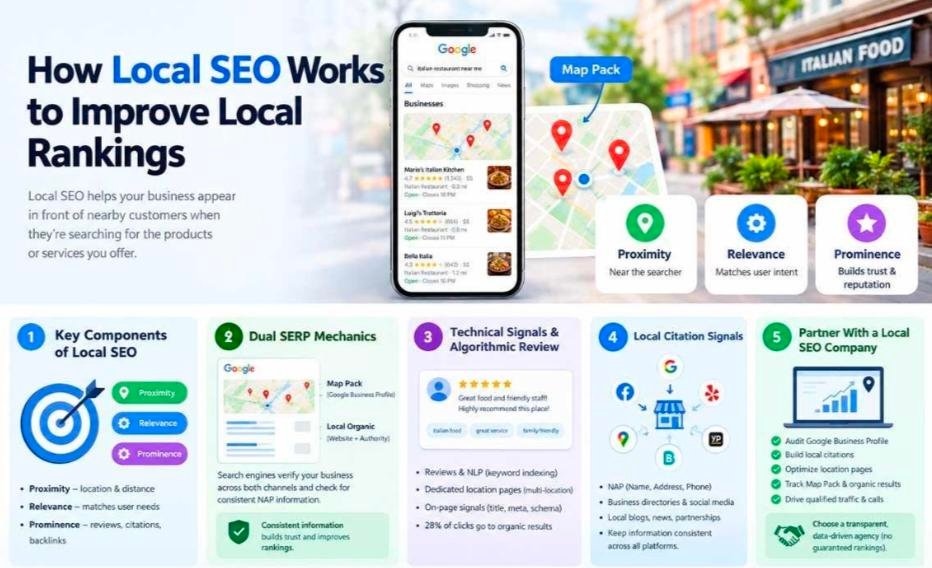

Local Search Engine Optimization is a specialized search system designed to provide users with accurate information about relevant businesses in their immediate vicinity.
When a customer performs a local search, for example, looking for an Italian restaurant or a plumber near me, search engines utilize their algorithms to display the most suitable businesses. This results in the presentation of listings within the Google Map Pack or Local 3 Pack, and local organic search results.
Local search algorithms do not rely solely on a website’s global authority or generic keywords. Instead, they evaluate businesses based on three core factors: Proximity, Relevance, and Prominence.
Understanding how these three factors interact provides a clear insight into how search engines determine local rankings.
Key Components of Local SEO – Match Your Business To Buyer Interest

Proximity refers to the geographical distance between the person searching and the business location. Even if a user does not specify a location in their search query, the search algorithm uses the device location data to automatically infer the user intent. The scope of this proximity can vary. For instance, when a user includes terms like best or open now, the algorithm expands its search radius to identify businesses that meet these criteria, such as those with high ratings or those currently open for business.
Relevance assesses how well a Google Business Profile aligns with a user specific needs. Selecting an accurate primary category is the most effective way to establish relevance. Additionally, various specific attributes serve as filters for the algorithm. When a user searches for particular features, the algorithm excludes profiles that do not possess those specific attributes.
Prominence refers to a business overall standing, recognition, and reputation within a given area. This is primarily measured based on customer reviews, citations, consistency of information, and inbound backlinks.
Dual SERP Mechanics and Data Consistency
Local search presents businesses to users through two interconnected channels. The Map Pack prioritizes proximity, precise categorization, and reviews sourced directly from a Google Business Profile. Below this lies the local organic ranking, which is driven by web crawlers that evaluate the overall website structure and domain authority.
To establish trust in a local business, search engines verify the accuracy of information across both these channels. The system continuously gathers business names, addresses, and phone numbers from various sources across the web and cross references them with the official profile.
Consistency of information across all platforms enhances the credibility of the data. Top performing businesses typically have an average of 86 accurate and consistent local citations. Discrepancies in information across different directories can confuse search crawlers, leading to reduced algorithmic trust and lower rankings.
Technical Signals and Algorithmic Review Processing
Customer feedback plays a significant role in local rankings. Search engines employ Natural Language Processing models to analyze the content and meaning within customer reviews. When customers naturally include keywords related to specific services in their reviews, the algorithm indexes these terms. Consequently, when users perform searches, even using long tail keywords, the business profile appears as a relevant result. A steady influx of new reviews signals to search engines that a business is active. Conversely, a long period without new reviews can lead to a decline in rankings over time.
The organic algorithm, which operates below the map pack, relies heavily on the structure of a local website. For businesses with multiple branches, having a dedicated landing page for each location is essential to securing a spot in the top organic search results. These organic listings typically capture about 28% of total clicks. Search engine crawlers analyze local page title tags, meta descriptions, and local business schema markup to assess the structural relevance of a website. By combining a robust, high performance technical framework with specific product names, such as one color polo, businesses can provide the precise signals to the algorithm required to improve overall visibility.
Local Citation Signals
A local citation refers to the mention of your business name, address, and phone number across various websites on the internet. In SEO terminology, this is commonly referred to as NAP. Citations occur when these core business details are listed in business directories, on social media profiles, or on review sites.

Citations are highly significant for local SEO. Search engines collect and verify your business information from various online sources. When your business name, address, and phone number are consistent across the web, it significantly enhances your business credibility in the eyes of search engines. Consequently, this improves your chances of achieving a higher position in local search rankings.
Maintaining consistent information across all platforms is crucial. The business name and address listed on your Google Business Profile must match the information provided in all other directories exactly. Even minor discrepancies or errors can confuse search crawlers and diminish the algorithm trust in your business.
You can easily build citations by creating business profiles in various well known online directories. Additionally, mentions of your business on local blogs, in news publications, or on the websites of business partners also serve as powerful citations. Consistently generating accurate citations significantly helps in boosting your business local prominence.
Why You Should Partner With A Local SEO Company
Managing multiple location pages, auditing hundreds of citations, and optimizing for generative answer engines requires significant resources. This is where partnering with a specialized local SEO company becomes a strategic advantage. As you scale your physical footprint, handling local search optimization internally often leads to inconsistent data and missed revenue opportunities.
A dedicated local SEO agency brings the technical infrastructure needed to deploy nested schema markup, analyze competitor proximity signals, and manage customer reviews at scale. When evaluating a local SEO company, look for absolute transparency in their reporting and a clear understanding of your specific market dynamics. Reputable agencies focus on driving qualified foot traffic and increasing phone call conversions. They build topical authority and improve overall visibility through data driven strategies. You should avoid any local SEO agency that promises guaranteed number one rankings on Google. Search algorithms are constantly evolving, and no ethical practitioner can make such absolute guarantees.
“A qualified local SEO company executes a systematic, long term approach rather than relying on empty ranking promises. They build the technical foundation your business needs to scale.”
Instead, a qualified local SEO company executes a systematic approach. They will thoroughly audit your existing Google Business Profile, identify missing local citations across data aggregators, and create hyper localized content that resonates with your target demographic. Whether you need to promote a specialized service or highlight physical retail products, an expert agency will structure your website architecture so search crawlers perfectly understand your offerings.
Furthermore, a proficient local SEO company will monitor your brand visibility across both the Map Pack and organic results. They will track how Natural Language Processing models interpret your customer reviews and adjust your content strategy accordingly. By outsourcing these highly technical tasks to an experienced agency, your internal team can focus entirely on closing inbound leads and delivering excellent customer service.
Conclusion
Local Search Engine Optimization is an ongoing process. It aligns your digital presence with the location and needs of your target audience. By effectively leveraging key algorithmic factors, proximity, relevance, and prominence, businesses can establish a lasting local presence.
Success requires maintaining consistent information across all platforms, continuously building a positive reputation, and ensuring your location pages are technically robust. These pages should include specific, detailed information, such as product specifics like one color polo shirts. Mastering these elements will help establish your business as the most reliable solution in the local market.
Frequently Asked Questions
How do customer reviews impact local search rankings?
Search algorithms evaluate reviews based on factors such as the total number of reviews, the average star rating, and how recent the reviews are. Furthermore, Natural Language Processing models extract specific keywords from customer feedback, which helps align your profile with user complex or long tail search queries.
What is NAP consistency?
NAP stands for Name, Address, and Phone number. Search engines collect information from various local directories to verify the authenticity of your business. If the information is inconsistent across these sources, search engine crawlers become confused. This directly diminishes your credibility in the eyes of the algorithms and lowers your local prominence score.
Why do businesses with multiple locations need separate landing pages?
Having a dedicated landing page for each location allows search engines to easily access specific geographic information, data that is crucial for ranking in local organic search results. Beyond driving organic clicks, these pages also help enhance the credibility of your Map Pack profile.