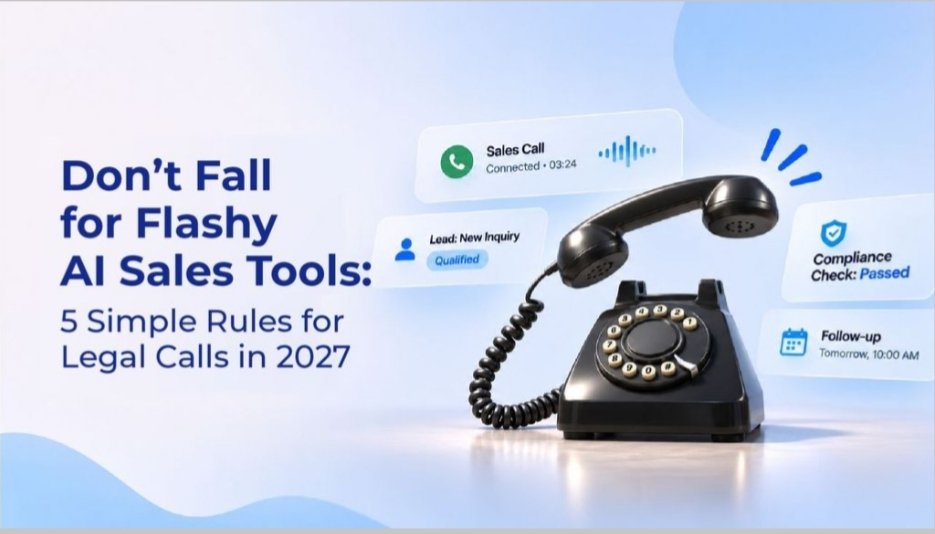

We are not giving our legal advice. The laws for making calls can change from one country to the other, and from one state to the next. Before you make any calls, it is important to consult your lawyer.
Several companies are launching AI sales tools that claim to be able to call thousands of leads within no time. The voice simulated by AI looks and sounds human.
However, the demos of this new technology do not tell you anything about the legal issue concerning making calls.
Any calling tool that gets the job done quickly but does not follow the callers’ rules can put one into a lot of trouble. It is enough to receive a picture of an upset customer to face real problems.
Fortunately, there are five rules that you do not have to be a lawyer or an expert to learn.
Rule 1: Get Permission Before You Call
The most important rule is often disregarded.
You can’t send msg to someone by automated system in many countries without their consent. For example, in the USA, there is a law called the Telephone Consumer Protection Act (TCPA). The regulators there have also mentioned that AI voices fall into the category of artificial voices.
What this means in plain words:
- A person who fills out form on your website and says “you can call me” is considered to give consent.
- Buying a list of phone numbers is risky because it has people who did not agree to receive messages from you.
- So always try to ensure that permission is explicit.
Simple test: Would the person be shocked to receive your call? If yes, stop and reconsider your policy.
When evaluating any AI marketing solution, ask yourself: “Does this tool allow me to demonstrate that each person has confirmed their consent?” If not, reject this product.
Rule 2: Be Honest That It’s an AI
Imagine making a call, having a pleasant conversation for a few minutes, and then realizing you were actually talking to a computer. Most people would feel duped.
Due to this, new laws are being introduced that require companies to disclose the fact that their calls are made by machines. Some companies now have to stop pretending, and others are in the process of making this happen.
Even if it isn’t required by law, being honest is considered the best practice.
A simple way to do it:
Start with, “Hi, it’s Olivia, a virtual assistant from [Your Company].”
That one statement is enough to gain people’s trust. People are usually happy to talk to AI unless they feel deceived.
Also remember:
- It is necessary to let people know who you are and where you work.
- Let your actual business number show up on the caller ID.
- Never let the machine say it is human or give a fake name.
Rule 3: Respect “Do Not Call” Lists and Calling Hours
Numerous countries maintain lists of persons who have made requests regarding their telemarketing calls, for instance, in the USA, that list is perfect from the legal perspective of the National Do Not Call Registry, while in India, this list is organized and handled according to the country’s laws.
Telemarketing companies calling people mentioned on these lists to face huge fines because of those violations.
Your safe checklist:
- Check to verify the lists at the beginning of every campaign you run and not once a month.
- Ensure to take into account whether a person wants to receive telemarketing calls and if the person states that “he/she doesn’t want to receive such calls anymore,” the telemarketing system should register this request and exclude the number from the list of calling recipients.
- In the USA, calling hours are usually restricted to the period from 8 am to 9 pm, while other countries also have their own regulations regarding telemarketing.
Here’s a warning sign: if a flashy AI tool brags about calling “any time, anywhere, non-stop,” be careful. Calling nonstop sounds powerful, but it’s often exactly how businesses get in trouble.
Rule 4: Be Careful with Recordings and Personal Information
Numerous sales tools utilize AI technology to record phone conversations and document their content. It is advantageous for the purposes of training and assessing quality, but the law has certain limitations.
The rules governing recording calls vary in different jurisdictions. In some locations, it is sufficient for only one party to the conversation to be aware of the recording. Other jurisdictions have stricter standards and require the consent of all parties involved in the conversation to record it. It is often impossible to know where the other party is located. Therefore, it is advisable to inform all participants of the call that the conversation will be recorded:
“This call may be recorded for quality and training purposes.”
Protect what you collect: During sales communication, you may gather information like names, telephone numbers, email addresses, and even economic data. Legislation on personal privacy such as GDPR in Europe, regional laws in the U.S., and India’s data privacy law can impose on you the following obligations:
- To gather only data that is absolutely required.
- To store it securely and privately.
- To get rid of the data when no longer needed.
- To allow a person’s right to see or delete his/her information upon request.
Before making a purchase, you should ask a vendor the following questions: “Where is my call data stored, who has access to it, and can I erase it?”
Rule 5: Keep a Human in Charge and Keep Good Records
AI is more of a helper than a leader. Even with great AI agents, there could be times when they misunderstand the question, say something wrong, or give a promise that cannot be followed up by the business.
Keep a human in the loop:
- Consider directing users to a human being by asking: “Would you like me to connect you to a specialist?” Starting from the very beginning of the project, make sure to monitor the performance of the calls or perform sample calls every week to spot the errors at the earliest stage.
- Never allow the AI system to promise anything in terms of pricing, results, or contracts unless you supervise the wording.
Keep your records:
In case the complaint arises, evidence is highly needed. Good pieces of evidence may be:
- How and when each of the assents was given.
- Which number has been checked against the DNC lists.
- Call logs with the dates and the times of the phone calls.
Any requests from the customers to stop calling them along with the date of fulfillment of the request.
A Quick Word on Flashy Sales Tools
This is how to tell tools that favor the looks over safety:
- It mentions speed and volume only, with no reference to the regulations that must be followed.
- It is unable to talk about how it operates, in terms of permissions or the role of Do Not Call lists.
- It conceals the fact that the voice on the phone is artificial.
- It does not offer adequate means to block phone calls or get rid of a number from its system.
- It is not willing to let you know where it sends your personal data.
The right tool will offer you great opportunities and be trustworthy at the same time.
Looking for a Safer Way to Use AI for Sales?
In case you are curious about how an AI sales assistant can work seamlessly in a business setting, you should check out Olivia the AI calling Agent from Pete & Gabi. Olivia has been created for assisting businesses in conducting their sales talks, enabling the teams to dedicate their time on matters of real relationships instead of repetitive activities. Before launching a campaign, the local calling regulations must be checked, permissions must be obtained, and it is necessary to inform the sales team when to intervene.
Frequently Asked Questions (FAQs)
1. Can I legally use an AI voice to make sales calls?
In numerous areas, the answer is indeed yes, yet it depends. Generally, proper authorization from the person is needed, the rules must be observed, and one must be frank about using an AI. The regulations differ from one nation and state to another; thus, one has to check the local legislation or consult lawyers prior to telemarketing.
2. Do I have to tell people they’re talking to an AI?
Some regions already require this, while others will inevitably demand it shortly. Even if one doesn’t have a legal obligation to do this, it is still a good idea to be honest from the very beginning by revealing the identity of the caller; for instance, one can say, “I am calling [Company].”
3. What happens if I call someone who is on a Do Not Call list?
There can be imposed big fees, which accrue per call placed, in addition to complaints and litigation processes. Thus, you must check your numbers against the list before each hardship.
4. Is it okay to record AI sales calls?
In most cases, yes. However, various laws exist in different states. Some countries require a single person’s agreement, while others do not consider it enough.