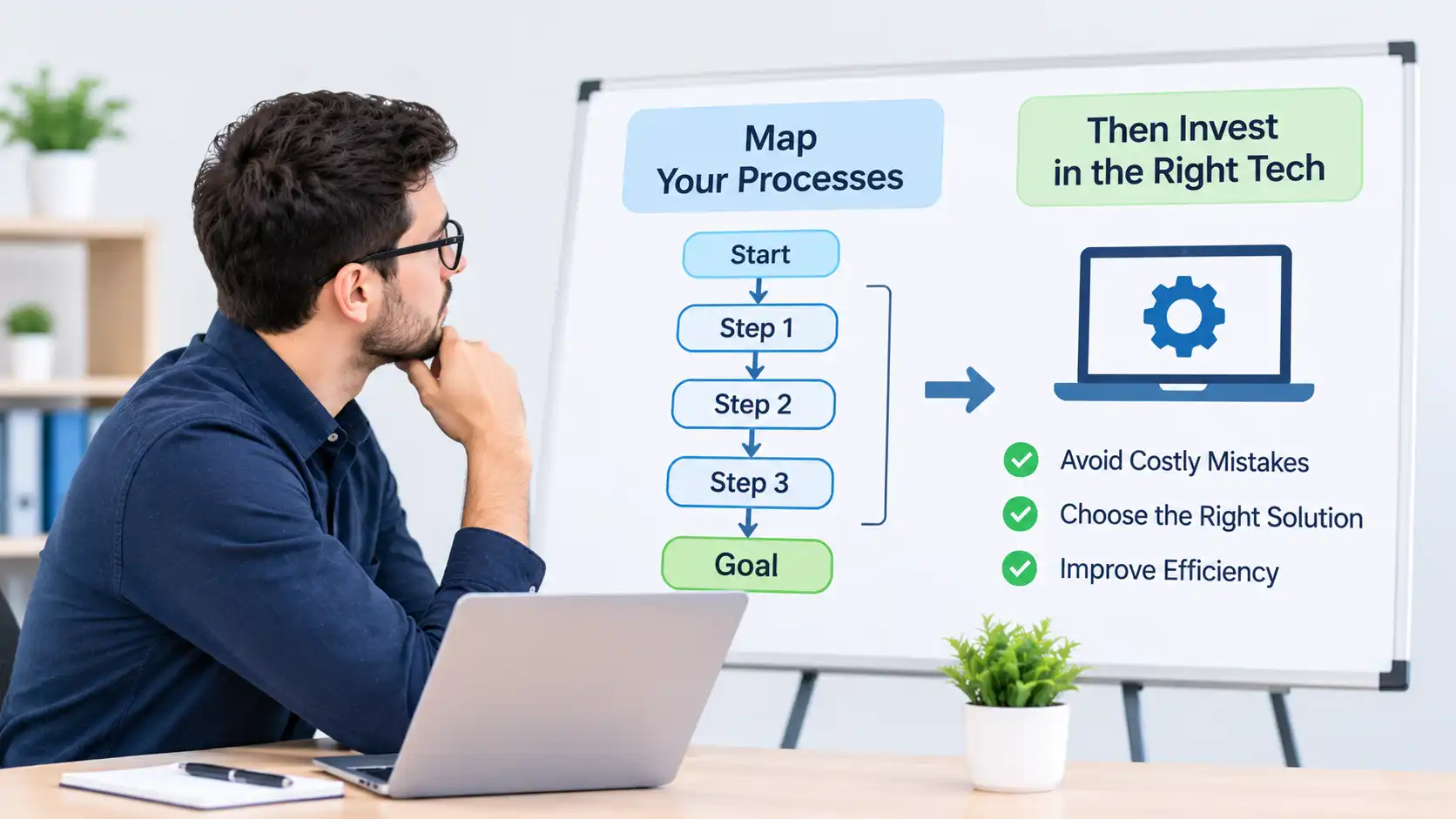

Businesses are constantly looking for ways to improve productivity. New software, digital platforms, and emerging technologies promise to make everyday operations faster and more efficient. However, buying another tool does not always solve the problems a business is trying to address.
In many cases, the real issue lies in how work gets done. Tasks may pass through too many people, information may be scattered across different systems, or employees may spend hours on administrative activities that add little value.
Before investing in new technology, businesses should take a closer look at their existing operations. Business process mapping provides a practical way to understand how work flows through an organization, identify inefficiencies, and make better decisions about where improvements are needed.
Why Technology Investments Don’t Always Solve Business Problems
It is tempting to assume that introducing new software will automatically improve productivity. When a team struggles with delayed approvals, for example, management might look for a new project management platform. When employees spend too much time handling paperwork, another digital tool may seem like the obvious answer.
But technology cannot always fix a poorly designed process.
Imagine a company where every purchase requires approval from three different managers. Employees regularly wait several days before receiving authorization, even for relatively small expenses. Introducing a new procurement platform might make requests easier to submit, but it will not necessarily resolve the delays caused by an unnecessarily complicated approval structure.
The same problem appears when departments use disconnected systems or rely on outdated procedures. Adding more software can create additional complexity instead of reducing it.
This is why businesses need to understand the underlying problem before choosing a solution. Otherwise, they risk spending money on tools that address symptoms rather than the actual causes of inefficiency.
What Is Business Process Mapping and Why Does It Matter?
Business process mapping is the practice of documenting how specific activities are completed within an organization. It provides a visual representation of the steps involved in a process, including the people responsible, information exchanged, decisions made, and potential delays.
Consider a company handling customer orders. A typical process might involve the sales team receiving an order, the inventory department checking product availability, the finance team confirming payment, and the fulfillment team arranging delivery.
On paper, these responsibilities might appear straightforward. However, the actual process could involve multiple emails, manual data entry, and repeated requests for information.
Mapping the process helps management see how these activities connect and where things start to go wrong.
It also encourages collaboration between departments. Rather than allowing each team to focus only on its own responsibilities, employees can understand how their work affects the wider organization.
More importantly, process mapping gives businesses a clearer starting point for deciding which improvements are worth making.
Five Common Operational Bottlenecks Businesses Should Look For
Before investing in new technology, organizations should pay attention to the everyday problems that slow down their operations. Some of the most common bottlenecks are easy to overlook because employees have become accustomed to working around them.
1. Repetitive Administrative Tasks
Employees sometimes enter the same information into several different systems. For example, a sales representative might record customer details in a CRM, send the same information through email, and update a separate spreadsheet.
These activities consume time without necessarily contributing additional value.
Over time, repetitive administrative work can reduce productivity and increase the likelihood of human error.
2. Delays Between Departments
A task may be completed quickly by one department but remain unfinished because another team has not provided the necessary information or approval.
This often happens in organizations where responsibilities are divided across multiple departments without clear communication procedures.
Mapping these handoffs can reveal where work frequently gets stuck and why certain tasks take longer than expected.
3. Disconnected Software Systems
Different departments often use separate applications to manage their daily responsibilities. While each tool might work well individually, problems arise when information cannot move easily between them.
Employees may need to download files, copy information manually, or contact colleagues to obtain updates.
These disconnected systems make it harder to maintain accurate records and give management a complete picture of business operations.
4. Unclear Responsibilities
When employees do not know who is responsible for a particular task, work can easily fall through the cracks.
For example, a customer request might be passed between several teams because nobody has clear ownership of the issue.
This can result in duplicated work, missed deadlines, and unnecessary frustration.
5. Excessive Manual Checks
Some businesses have approval and verification procedures that involve more steps than necessary.
Reviewing financial documents, checking supplier information, or confirming order details can be important. However, repeatedly reviewing the same information without a clear reason can slow down otherwise straightforward processes.
Understanding why these checks exist can help organizations determine whether procedures need to be simplified or supported by better technology.
How to Evaluate Existing Processes Before Choosing Software
Identifying potential bottlenecks is only the beginning. Businesses also need a practical way to evaluate their existing processes before deciding what should change.
Document How Work Actually Happens
Start by speaking with employees who perform the tasks every day. Official process documentation does not always reflect what happens in practice.
Ask employees to explain their responsibilities, the tools they use, the people they depend on, and the problems they encounter.
Observing actual workflows can reveal informal procedures and workarounds that management might not know about.
Measure Time and Resource Consumption
Understanding how long a process takes is important when evaluating its efficiency.
Businesses should identify how much time employees spend completing individual tasks, waiting for approvals, correcting mistakes, and transferring information between systems.
These observations provide a baseline for measuring whether future improvements actually make a difference.
Separate Essential Tasks From Unnecessary Steps
Not every step in a business process contributes meaningful value.
Some procedures exist because of regulatory requirements, financial controls, or customer expectations. Others may simply reflect decisions made years ago that nobody has revisited.
Businesses should distinguish between necessary activities and unnecessary complexity before attempting to redesign a process.
Prioritize Problems Based on Business Impact
Trying to fix every inefficiency at once can quickly become overwhelming.
Instead, organizations should prioritize problems based on their impact on operational costs, employee productivity, customer satisfaction, and overall performance.
A process that regularly delays customer orders, for instance, might deserve attention before a minor administrative inconvenience.
Turning Process Insights Into Smarter Technology Decisions
Once businesses understand how their operations work, they can make more informed decisions about technology investments.
Some problems may only require clearer responsibilities, better communication, or revised internal procedures. Others might benefit from integrating existing software, improving data management, or introducing digital tools.
For repetitive activities that consume significant employee time, automation may also be worth considering.
Organizations can explore different approaches to streamlining repetitive work through workflow automation. The important thing is to understand which activities should be improved before deciding how technology can support them.
Businesses should also evaluate potential solutions based on practical outcomes rather than the number of features they offer. A platform with dozens of capabilities is not necessarily the right choice if the organization only needs to solve a specific operational problem.
Starting with clearly defined requirements makes it easier to compare solutions, manage implementation costs, and measure results.
Build a Technology Strategy Around Real Business Needs
Technology investments should support business objectives, not become objectives themselves.
Organizations that take the time to examine their processes are better equipped to recognize where improvements are genuinely needed. They can avoid purchasing unnecessary software, reduce operational complexity, and focus resources on problems that have the greatest impact.
This does not mean businesses need to document every activity before adopting new technology. Even reviewing a few important processes can uncover opportunities that might otherwise remain unnoticed.
Successful digital transformation starts with understanding how work gets done. When businesses have that understanding, they are in a much stronger position to choose technology that delivers meaningful improvements.