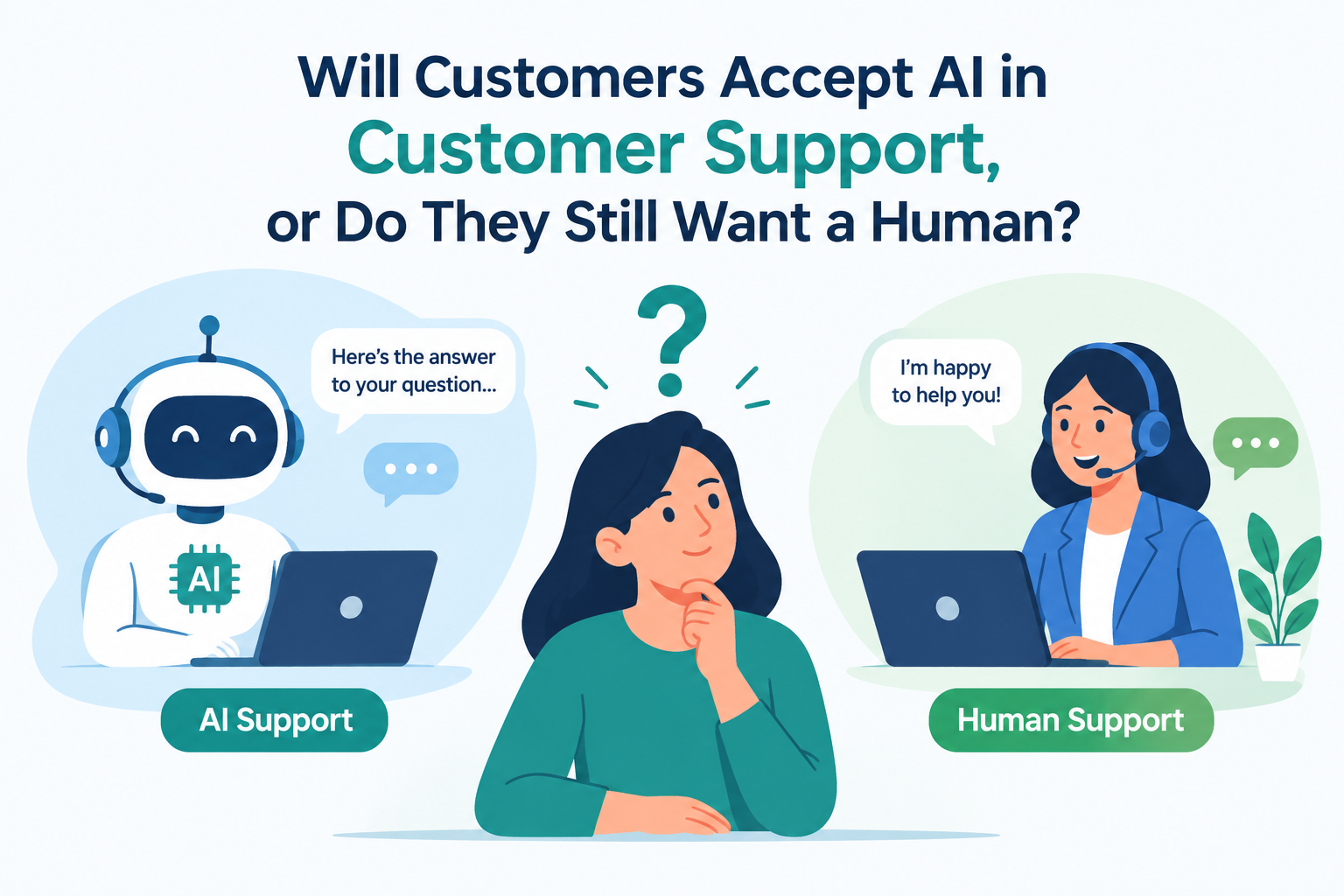

Yes, if it fixes the problem fast and gets the answer right. And when it can’t, a real person has to be easy to reach.
Ask people and most still say they’d rather talk to a human. Watch what they do and it changes. Verint’s May 2026 survey found 69% of customers would switch from human service to automation if it resolved their issue. People don’t want a human. It is just that they want their problem to be solved.
Next: what customers say versus what customers really do, where AI in customer support earns trust, and how to delegate it to a human without making them repeat themselves.
What Customers Say About AI in Customer Support
Most people say they want a human. In SurveyMonkey’s 2025 study, 79% of Americans strongly preferred a person over an AI agent. Only 8% favored AI, and they named availability (41%), speed (37%) and accuracy (30%) as the reasons.
Gartner’s February and March 2026 survey of 3,566 customers shows the split. Half said interactions are easier when companies use generative AI. But 87% said reaching a human agent is essential. They like the speed and still want the exit.
Verint’s 2026 State of CX report found 61% prefer a human, up 5% from last year.
Age matters too. SurveyMonkey found Gen Z and Millennials are more open to AI, as long as it matches a human agent on speed and quality.
What Customers Actually Do
What people say and what they do don’t match. In the same May 2026 survey, Verint found that 78% of customers rank fast resolution above their preferred channel. And 79% would leave for a competitor after one bad experience. Among 18 to 34 year olds, 93% would switch to AI that actually resolves their issue.
I think people ask for humans because they expect the bot to fail. It loops. It gives wrong answers. It offers no way out. They’re reacting to wasted time, not to the technology itself.
Gartner’s survey points the same way. The mainreason people gave for trying AI was knowing they could reach a person.
So treat the preference for humans as a design requirement. Build the escape route first. If you’re deciding whether to run this in-house or outsource it, our list of the best omnichannel customer support outsourcing companies is a good place to start.
When Customers Accept AI and When They Want a Human
| Situation | Recommended channel | Rationale |
| Order status, store hours, password resets | AI | Deterministic answers; speed is the dominant criterion |
| Booking changes, simple refunds | AI with human fallback | Routine, but errors carry financial consequences |
| Billing disputes, cancellations, complaints | Human | Requires judgment and empathy |
| Health, financial or emotionally charged issues | Human | High stakes; trust is paramount |
| Repeat contact on an unresolved issue | Human, immediately | The customer’s patience is already depleted |
AI in customer support performs best on routine, verifiable tasks, though expectations are shifting from answering to acting: Gartner found that 58% of customers who use generative AI have used it to complete a task on their behalf.
How AI in Customer Support Goes Wrong
Most bad bot chats go wrong in one of three ways. It misunderstands you, it repeats itself, or it blocks the way to a human.
Gartner warns against making generative AI the mandatory first step. Customers pushed through several failed AI exchanges get less willing to use it again. According to a Gartner survey 2026 only 27% of customers would try a chatbot again after a bad experience.
The handoff is where trust usually breaks. If I have to explain my problem a second time, I don’t care whether the first answer came from software or a person. I’m already annoyed.
How to Hand Off From AI to a Human Agent
Four things make a handoff work.
- Offer a human from the first message. Don’t make customers fail their way to one.
- Pass the whole context along. The agent should see the full transcript, the customer’s account and what the bot already tried, so nobody repeats themselves.
- Escalate without being asked. Trigger it when someone repeats a question, types “agent” twice, or raises billing or cancellation.
- Track resolution, not deflection. A chat that closes without fixing anything counts as a failure.
None of this works if the agent on the other end can’t solve the problem. That’s why many companies hire customer support services to cover chat, email and voice around the clock. Someone has to be there when the bot gives up.
How to Build Customer Support Customers Trust
Start small. Take the five questions your team answers most, like order status, password resets and store hours, and automate just those. Tell customers up front they’re talking to AI. Nobody likes finding out halfway through.
Then read a sample of conversations every week. You’ll spot where the bot misreads people or gives a bad answer, and you can fix those first. Keep humans for the messy cases: refunds, complaints, anything where the customer is upset or the account is at risk.
The Bottom Line
Customers aren’t against AI. They’re against being stuck. Give them a bot that answers fast and gets it right, and a person who already knows the story when it can’t, and most will happily use it.
Get either wrong and they won’t give you a second try. In Verint’s survey, 79% would leave after a single bad experience.
If you’d rather avoid the “aren’t against X, they’re against Y” shape entirely, here’s a blunter option:
Customers will use AI support when it works. When it doesn’t, they want a person fast, and they’ll leave if they can’t get one. With 79% ready to switch after one bad experience, you don’t get many chances.
Frequently Asked Questions
Do customers prefer AI or human customer support?
Most say they prefer humans. SurveyMonkey’s 2025 study found 79% of Americans strongly prefer a person. What they do is different. Verint’s 2026 survey found 69% would switch to automation if it solved their problem. Speed and accuracy decide whether they accept AI.
When should businesses use AI in customer support?
Use it for routine questions with one right answer, like order tracking, store hours and password resets. Keep humans on billing disputes, complaints and cancellations. A good rule: automate where speed matters most and a wrong answer costs little.
Why do customers still want a human in customer support?
They expect the bot to get complex or emotional issues wrong. Gartner’s 2026 survey found 87% of customers say access to a human agent is essential. When the stakes are high, people want someone who can use judgment and show they care.
How can companies make AI in customer support less frustrating?
Let customers reach a person at any point. Pass the full conversation along so nobody repeats themselves. Escalate when a customer types “agent” twice or repeats a question. And track whether problems got solved, not just whether chats ended.