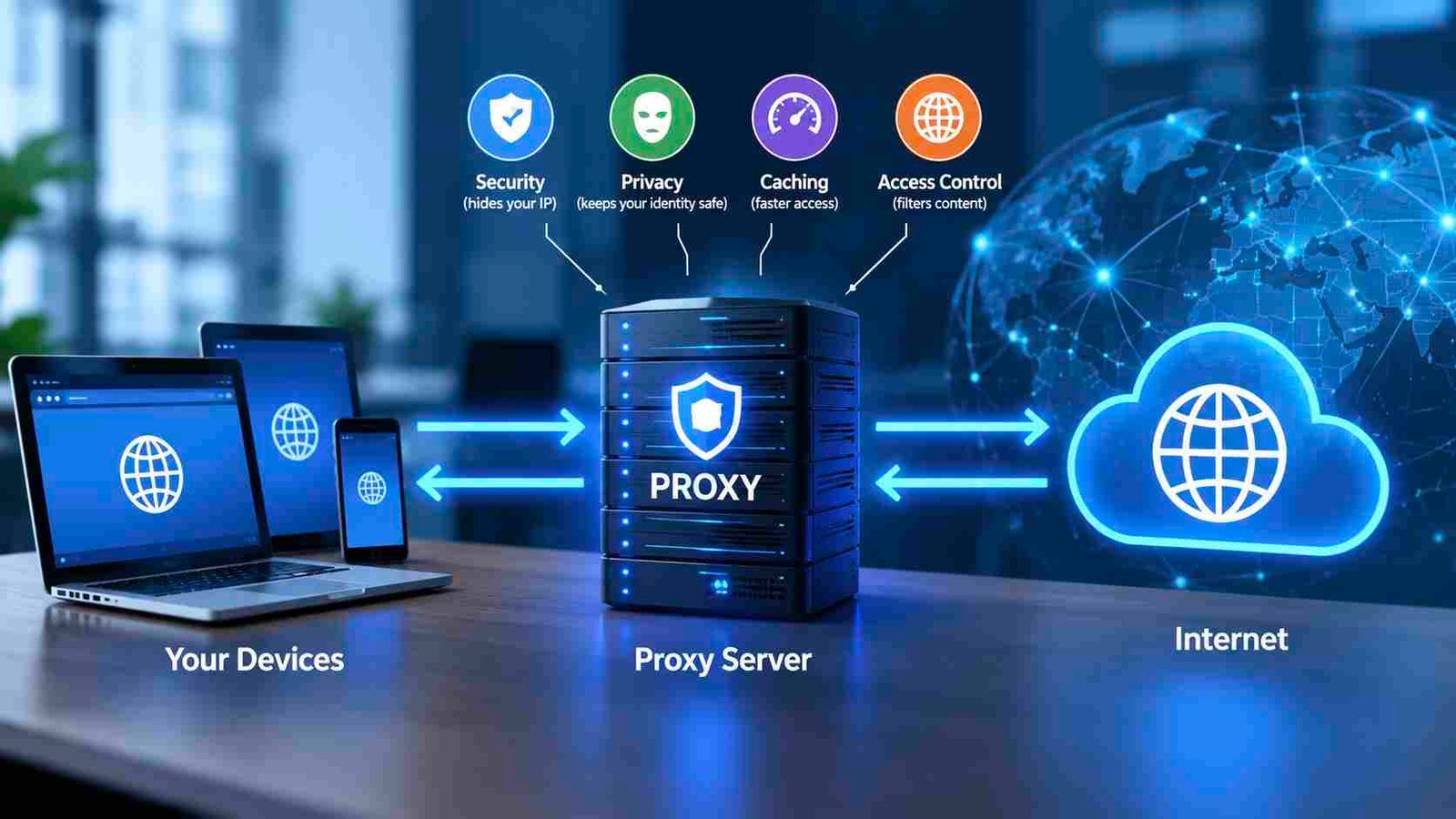

Every request leaving a network carries an IP address, and that address says more than most people expect: rough location, connection type, and the company that issued it. Proxy servers exist to change what the other side sees.
The idea isn’t new. But how engineers use proxies today, for price monitoring, ad verification, and distributed application testing, has little in common with the caching servers of the late 1990s.
What a proxy server actually does
A proxy accepts a client request, forwards it under its own identity, then hands the response back. The destination logs the proxy’s address, not the original one.
Forward proxies manage outbound traffic from clients. Reverse proxies do the opposite, sitting in front of web servers to spread load and filter what comes in, which is why nearly every high-traffic site runs one whether visitors notice or not.
Where the IP comes from decides everything
The plumbing is the easy part. What determines whether traffic gets through is the origin of the IP address, and there are three sources worth knowing.
Residential IPs come from ordinary home connections verified by an internet service provider. Datacenter IPs are spun up virtually on commercial servers owned by hosts such as AWS or DigitalOcean, which makes them cheap and fast but far easier to flag. Mobile IPs route through cellular networks and carry the most trust, at the steepest price.
Each category splits further by access model (shared, semi-private, or private) and by rotation behavior (static or rotating). IPRoyal’s blog on types of proxy lays out how those variables combine in practice.
Budget usually settles the argument. A team scraping 10 million product pages a month can’t afford residential bandwidth, while a team verifying ad placements in Seoul can’t afford to get blocked on request one.
Protocols and the details people skip
HTTP proxies handle web traffic and can read request headers, which suits caching and content filtering. SOCKS5 operates lower down, passing any TCP or UDP traffic without caring what’s inside it: email, FTP, database queries, game clients.
That difference isn’t academic. RFC 1928, the IETF specification for SOCKS5, defines an authentication handshake and multiple address types, which makes it the sensible pick for anything beyond browser traffic.
Authentication is the other choice that gets made carelessly. Username and password pairs work from any machine but leave credentials sitting in scripts and config files, while IP whitelisting removes the passwords and locks access to fixed origins. Teams running jobs from rotating cloud instances usually regret picking the second option.
Then there’s the question of what a proxy leaks. Badly configured forward proxies pass along X-Forwarded-For headers naming the original client, defeating the whole point. Wikipedia’s entry on proxy servers documents that failure mode alongside the transparent proxy behavior that still surprises plenty of network admins.
Detection is an arms race, not a solved problem
Websites maintain databases of IP ranges assigned to hosting companies, and checking an incoming address against them takes milliseconds. That’s why datacenter traffic runs into CAPTCHAs faster than residential traffic, sometimes on the very first request.
And fingerprinting has moved well past IP reputation. TLS handshake signatures, canvas rendering quirks, mouse movement, request timing: Cloudflare’s bot management documentation explains how these signals roll up into a single score from 1 to 99, where anything under 30 usually gets treated as automated. Swapping IPs alone won’t move that number much.
The practical response is boring, which is probably why it gets ignored. Rotate sensibly (two or three requests per IP for aggressive collection, full session persistence for anything behind a login), keep initial request rates near one per second, and match proxy location to the content being requested.
Location matters more than most buyers assume. Pricing data on a German retail site can differ from what an Austrian IP sees, and no amount of speed fixes a dataset collected from the wrong country.
What changes next
IPv6 is the shift worth watching. Address scarcity has shaped proxy pricing for a decade, and providers holding IPv6 allocations can hand out vastly larger pools per customer, though plenty of target sites still handle IPv6 connections poorly.
Edge computing pulls in the other direction, moving proxy endpoints closer to end users and cutting round trip latency toward single digits in well-served regions. Teams building anything that depends on proxy infrastructure should plan around both changes now, not after their current setup starts failing.