
You know the difference between a “boss” and a “visionary” isn’t just their salary – it’s the language we use to define them. Whether you are updating your LinkedIn profile, writing a performance review, or drafting a keynote speech, the words you choose carry weight. Using generic terms like “good” or “nice” is a missed opportunity to capture the nuance of true influence.
Leadership isn’t a monolith; it’s a spectrum. A startup founder needs a different set of adjectives to describe a leader than a seasoned non-profit director. In this guide, we’ll explore the power of vocabulary to help you find the perfect synonyms for leadership qualities and elevate your professional communication.
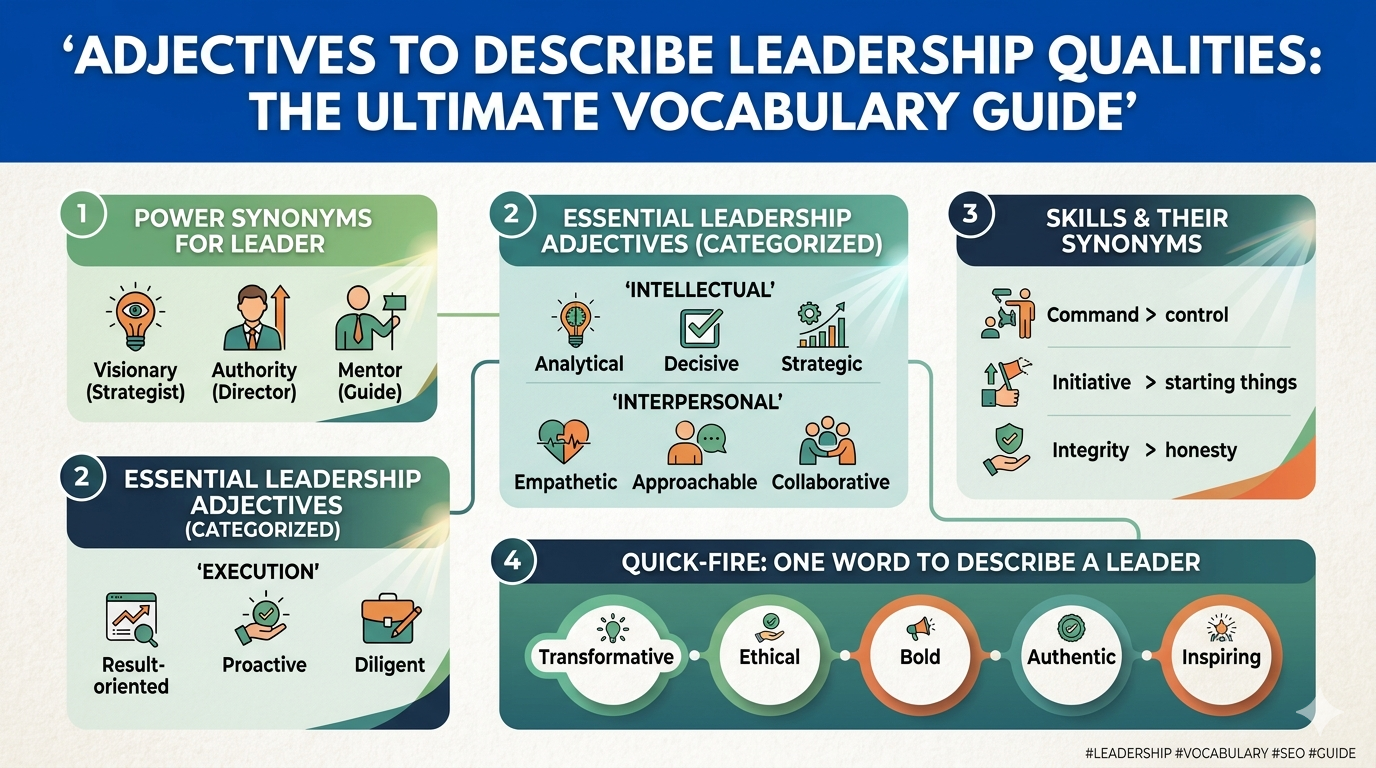
Another Word for Leader: Power Synonyms for Every Context
Whenever the word “leader” feels a bit exhausted. To stand out, you need another word for leader that fits the exact “vibe” of the role. Depending on the environment – from a tech hub in San Francisco to a financial firm in London – the nuance matters.
The Visionary
These are the people looking ten years into the future.
- Pioneer: For those breaking new ground in uncharted territory.
- Pathfinder: Someone who finds a way through complex challenges.
- Strategist: Ideal for leaders who excel at long-term planning and tactical execution.
- Architect: Perfect for someone who builds systems, cultures, or organizations from the ground up.
The Authority
When the role is about oversight, governance, and maintaining order.
- Director: Implies a high level of administrative control.
- Administrator: Focuses on the efficiency and “gears” of an organization.
- Principal: Carries a sense of seniority and foundational importance.
- Captain: Suggests a hands-on approach to steering a team through rough seas.
The Mentor
For the leader who focuses on the growth of their people.
- Guide: A gentle but firm hand in professional development.
- Advisor: Someone valued for their wisdom and expertise.
- Facilitator: A leader who makes processes easier for others.
- Steward: Implies a deep responsibility for the organization’s well-being.
Essential Adjectives to Describe a Leader (Categorized)
To really capture someone’s heart, you need specific adjectives to describe leadership qualities. We’ve broken these down into three pillars of distinction.
Intellectual Leadership Qualities
These words explain how a leader thinks and processes information.
- Analytical: They don’t just guess; they use data to drive decisions.
- Decisive: In moments of uncertainty, they dare to make a call.
- Strategic: Every move is part of a larger, cohesive plan.
- Insightful: They see the “why” behind the “what.”
- Perspicacious: (A high-level term) Having a ready insight into and understanding of things.
Interpersonal & Emotional Leadership
Leadership is a people industry. These words for leadership skills emphasize dynamic intelligence (EQ).
- Empathetic: They understand the personal challenges their team members face.
- Approachable: There is no “ivory tower”; they are available for conversation.
- Collaborative: They believe the best ideas come from the collective, not the individual.
- Motivational: They have the innate ability to spark a fire in others.
- Relatable: They lead with a human touch, making them easy to follow.
Execution & Performance Traits
Ultimately, a leader must provide. Here are adjectives for the “doers.”
- Result-oriented: They keep their eyes on the prize and ignore the noise.
- Proactive: They solve problems before they even manifest.
- Diligent: They are thorough, persistent, and pay attention to detail.
- Resilient: When things go wrong, they bounce back faster than anyone else.
- Methodical: They follow a proven process to ensure consistent success.
Synonyms for Leadership Qualities and Skills
If you are writing a resume, you want to avoid replicating the word “leadership” five times in one paragraph. Instead, use these synonyms for leadership qualities to describe specific skills:
- Command instead of “Control”: Command implies earned respect and natural authority, whereas control can sound micromanaging.
- Initiative instead of “Starting things”: “Demonstrated initiative” sounds significantly more professional than “started some projects.”
- Integrity instead of “Honesty”: Integrity implies a wholeness of character – doing the right thing even when no one is looking.
- Diplomacy instead of “Talking”: Essential for leaders who navigate office politics or high-stakes negotiations.
- Fortitude instead of “Bravery”: This describes a quiet, steady strength in the face of long-term adversity.
Searching for One Word to Describe a Leader?
If you only have space for a single, punchy word – perhaps for a headline or a bold bio – choose one of these high-impact options:
- Transformative: For the leader who changes the very nature of their organization.
- Ethical: In an era of corporate scrutiny, this is a powerful badge of honor.
- Bold: For the risk-taker who isn’t afraid to fail.
- Authentic: For the leader who remains true to their values regardless of pressure.
- Inspiring: The gold standard of leadership—someone people want to follow.
How to Use These Words in a Professional Context
Context is everything. An adjective that works for a creative director at a boutique agency might fall flat for a CFO at a global bank.
- For Tech & Innovation: Use words like Agile, Disruptive, and Adaptive. These industries value speed and the ability to pivot.
- For Traditional Sectors (Law, Finance): Lean toward Steadfast, Prudent, and Authoritative. These fields value stability and heritage.
- For Creative Fields: Opt for Articulate, Imaginative, and Intuitive.
- For Modern Global Markets: In 2026, the global economy is increasingly volatile. If you are discussing the impact of external factors – like the recent oil price spike in March 2026 – you might describe a leader as Pragmatic or Vigilant in their risk management.
Pro-Tip: When using these words in a resume, don’t just list them. “I am a decisive leader” is a claim. “I orchestrated a department-wide pivot that increased ROI by 15%” is proof. Use these adjectives to frame your achievements.
To further enhance your professional profile, you might also be interested in our deep dive into Soft Skills for Career Growth.
FAQ: Frequently Asked Questions about Leadership Vocabulary
What is another word for leadership?
Depending on the context, you can use Directorship, Guidance, Governance, Stewardship, or Management. If you are referring to the act of leading, Command or Supervision also work well.
What are 3 adjectives to describe a good leader?
While it depends on the role, the three most universally respected adjectives are Integrity-driven, Decisive, and Empathetic. This covers the ethical, tactical, and human elements of the job.
How do you describe leadership skills on a resume?
Avoid “I am a leader.” Instead, use action-oriented synonyms and verbs. Use words like “Spearheaded,” “Cultivated,” “Orchestrated,” or “Galvanized” to describe your impact.
What is a “transformational” leader?
A transformational leader is someone who inspires followers to exceed their own self-interests for the good of the organization. Key adjectives for them include Empowering, Visionary, and Charismatic.